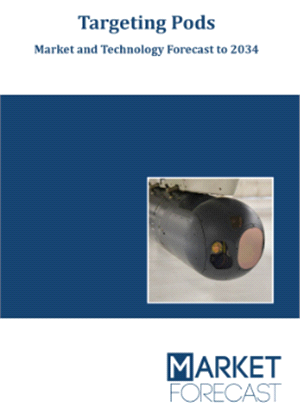
Targeting Pods - Market and Technology Forecast to 2033
Targeting Pods - Market and Technology Forecast to 2033
Market forecast by Region, Designator Pod, Platform, and End User. Country Analysis, Market and Technology Overview, Critical Raw Materials, Opportunity Analysis, and Leading Company Profiles
Market forecast by Region, Designator Pod, Platform, and End User. Country Analysis, Market and Technology Overview, Critical Raw Materials, Opportunity Analysis, and Leading Company Profiles
Precision strike capabilities remain a cornerstone of modern aerial warfare. As evidenced by recent high-intensity operations in Ukraine, Syria, and other geopolitical hotspots, the ability to identify, track, and designate targets with pinpoint accuracy is indispensable. Consequently, the global appetite for advanced electro-optical and infrared targeting systems is expanding rapidly.
While the United States maintains its position as both the primary consumer and exporter of these sophisticated sensors, there is a marked surge in procurement across Asia and the Middle East. Our research suggests this upward trajectory in demand will persist and accelerate throughout the forecast period.
This report offers a detailed examination, analysis, and projection of the targeting pod market’s evolution, covering technology trends, commercial landscapes, and expenditure forecasts for the eight-year period: 2026–2034. The study encompasses the vast majority of the global marketplace, with a specific focus on the dominant regions: the Americas, Europe, Asia, the Middle East, and Africa.
Currently, the United States leads the sector in terms of market size, with the European Union and China representing significant secondary markets. The report highlights how targeting pods act as critical force multipliers for the air forces of the US, China, and other major powers. To ensure a robust and realistic outlook, the analysis employs a twin-scenario approach, evaluating both a "steady-state" progression and the disruptive potential of emerging sensor technologies.
Scope of the Study
- Overview: A comprehensive snapshot of targeting pod technology within the defence sector for 2026–2034. This includes an assessment of primary demand drivers, key trends, and operational challenges. It also breaks down spending by region and segment, whilst highlighting the arrival of next-generation sensor fusion capabilities.
- Market Dynamics: An investigation into technological leaps within the optical tracking domain and a thorough evaluation of shifting procurement preferences among global governments. The section also scrutinises the evolving industrial structure and the hurdles facing manufacturers.
- Segment Analysis: A breakdown of the market from a component and platform perspective, detailing the specific variables driving growth in each category.
- Regional Review: An exploration of fleet modernisation patterns and defence budget allocations for the leading nations within each geographic block.
- Regional Analysis: A deep dive into the systems market by territory, identifying the unique geopolitical and operational factors influencing regional demand.
- Trend Analysis: An assessment of key markets, predicting which specific sensor configurations and pod capabilities will face the highest demand in each area.
- Key Programme Analysis: Detailed profiles of the major procurement and upgrade programmes expected to launch or continue during the forecast window.
- Competitive Landscape: A review of the industry’s commercial terrain. This includes profiles of leading OEMs (Original Equipment Manufacturers), alongside data on strategic alliances, mergers, and a synopsis of financial health.
Market Segmentation
The targeting pod market is categorised by Region, Technology, Platform and End User
Region- North America
- Europe
- Asia Pacific
- Middle East & Africa
- Latin America
- FLIR (Forward-Looking Infrared) & Thermal Imaging
- FLIR – Laser
- Laser
- Combat Aircraft
- Unmanned Aerial Vehicles (UAVs)
- Helicopters
- Bombers
- Air Force
- Army
- Navy
Reasons to Buy
- Strategic Investment Planning: Identify lucrative investment avenues through a rigorous trend analysis of the global targeting pod market spanning the next eight years.
- Demand Insight: Acquire a profound understanding of the fundamental factors fuelling the need for various sensor segments in the world’s top defence-spending nations, identifying specific opportunities in each.
- Market Intelligence: Bolster your knowledge of the sector regarding demand stimulants, industrial shifts, and the latest breakthroughs in electro-optical technology.
- Revenue Growth: Pinpoint the primary procurement channels driving the global business, offering a transparent view of future commercial opportunities that can be leveraged for revenue expansion.
- Resource Allocation: Direct your resources effectively by focusing on active and upcoming modernisation programmes initiated by defence ministries globally.
- Competitive Advantage: Formulate sound business strategies based on a comprehensive analysis of the competitive environment, featuring detailed dossiers on top system providers, their product portfolios, strategic partnerships, recent contract awards, and financial performance.
Related studies:
1.1 Trends and Insights
1.2 Main Findings
1.2.1 Targeting Pods market summary by Region
1.2.2 Targeting Pods market summary by Pod Designator Types
1.2.3 Targeting Pods market summary by Platform
1.2.4 Targeting Pods market summary by End-User
1.3 Key Conclusions
2 Introduction
2.1 Scope
2.2 Methodology
2.3 Who will benefit from this study?
3 Technologies and Developments
3.1 Targeting Pod Technology Overview
3.2 Technology Development
3.3 Types of Targeting Pod
3.3.1 Forward Looking Infra-Red Pods (FLIR)
3.3.2 FLIR – Laser
3.3.3 Laser
3.4 Technology Readiness Level
3.5 Ongoing Research for Targeting Pod -related technology
3.6 Future Outlook and Industry Evolution
4 Critical Raw Materials
4.1 Core CRMs in Targeting Pod Manufacturing
4.1.1 Optical and Sensor Systems
4.1.2 Laser Designation Systems
4.1.3 Electronics and Computing
4.1.4 Structural and Thermal Management
4.1.5 Stabilization and Precision Mechanics
4.2 Critical Vulnerabilities:
4.2.1 Tier 1 Strategic Vulnerabilities (Immediate Crisis in Conflict Scenario)
4.2.2 Tier 2 Significant Risks (6-18 Month Vulnerability)
4.3 Material Adequacy Assessment for 1580-Pod Annual Production
4.3.1 GREEN (Adequate Low-Risk Supply)
4.3.2 YELLOW (Manageable with Strategic Reserves & Recycling)
4.3.3 RED (Critical Vulnerability - Immediate Strategic Intervention Required)
4.4 Strategic Recommendations for NATO CRM Security
4.4.1 Immediate Actions (0-24 Months)
4.4.2 Medium-Term Actions (2-5 Years)
4.4.3 Long-Term Strategic Independence (5-10 Years)
5 Market Overview
5.1 Introduction
5.2 Targeting Pod market volume distribution over forecast period by Region
5.3 Current Status of the Targeting Pod Market
5.4 Major Products in the Targeting Pod Business
5.5 Competitive landscape
5.6 Major Companies
5.7 Challenges and Opportunities
5.8 Market Assessment for Business Developers
5.9 Market Assessment for Investor Community
5.10 Market Assessment for Government and Defence Agencies
5.11 Procurement Considerations
5.12 Investment Requirements
6 Market Dynamics and Forecast Factors
6.1 Market Segmentation
6.2 Drivers
6.3 Trends
6.4 Opportunities
6.5 Challenges
6.6 Forecast Factors and Notes
6.6.1 Base Scenario
7 Country Analysis
7.1 Overview
7.2 North America
7.2.1 Canada
7.2.2 Mexico
7.2.3 United States
7.3 Europe
7.3.1 Austria
7.3.2 Belgium
7.3.3 Denmark
7.3.4 Finland
7.3.5 France
7.3.6 Germany
7.3.7 Greece
7.3.8 Italy
7.3.9 Netherlands
7.3.10 Norway
7.3.11 Poland
7.3.12 Portugal
7.3.13 Spain
7.3.14 Sweden
7.3.15 Switzerland
7.3.16 Türkiye
7.3.17 Ukraine
7.3.18 United Kingdom
7.4 Asia Pacific
7.4.1 Australia
7.4.2 China
7.4.3 India
7.4.4 Indonesia
7.4.5 Japan
7.4.6 Pakistan
7.4.7 Philippines
7.4.8 Russia
7.4.9 Singapore
7.4.10 South Korea
7.4.11 Taiwan
7.4.12 Thailand
7.5 Middle-East & Africa
7.5.1 Algeria
7.5.2 Egypt
7.5.3 Iran
7.5.4 Iraq
7.5.5 Israel
7.5.6 Kuwait
7.5.7 Morocco
7.5.8 Saudi Arabia
7.5.9 South Africa
7.5.10 United Arab Emirates
7.6 Latin America
7.6.1 Argentina
7.6.2 Brazil
7.6.3 Chile
7.6.4 Colombia
8 Targeting Pods market to 2034 by Region
8.1 Targeting Pods market by Region overview
8.2 Targeting Pods market Region by Pod Designator Types overview
8.2.1 North America market by Pod Designator Types overview
8.2.2 Europe market by Pod Designator Types overview
8.2.3 Asia Pacific market by Pod Designator Types overview
8.2.4 Middle-East & Africa market by Pod Designator Types overview
8.2.5 Latin America market by Pod Designator Types overview
8.3 Targeting Pods market Region by Platform overview
8.3.1 North America market by Platform overview
8.3.2 Europe market by Platform overview
8.3.3 Asia Pacific market by Platform overview
8.3.4 Middle-East & Africa market by Platform overview
8.3.5 Latin America market by Platform overview
8.4 Targeting Pods market Region by End-User overview
8.4.1 North America market by End-User overview
8.4.2 Europe market by End-User overview
8.4.3 Asia Pacific market by End-User overview
8.4.4 Middle-East & Africa market by End-User overview
8.4.5 Latin America market by End-User overview
9 Targeting Pods market to 2034 by Pod Designator Types
9.1 Targeting Pods market by Pod Designator Types overview
9.2 Targeting Pods market Pod Designator Types by Region overview
9.2.1 Flir and Laser Designator Pods market by Region overview
9.2.2 Laser Designator Pods market by Region overview
9.2.3 Flir Designator Pods market by Region overview
9.3 Targeting Pods market Pod Designator Types by Platform overview
9.3.1 Flir and Laser Designator Pods market by Platform overview
9.3.2 Laser Designator Pods market by Platform overview
9.3.3 Flir Designator Pods market by Platform overview
9.4 Targeting Pods market Pod Designator Types by End-User overview
9.4.1 Flir and Laser Designator Pods market by End-User overview
9.4.2 Laser Designator Pods market by End-User overview
9.4.3 Flir Designator Pods market by End-User overview
10 Targeting Pods market to 2034 by Platform
10.1 Targeting Pods market by Platform overview
10.2 Targeting Pods market Platform by Region overview
10.2.1 Combat A/C market by Region overview
10.2.2 Drones market by Region overview
10.2.3 Helicopters market by Region overview
10.2.4 Bombers market by Region overview
10.3 Targeting Pods market Platform by Pod Designator Types overview
10.3.1 Combat A/C market by Pod Designator Types overview
10.3.2 Drones market by Pod Designator Types overview
10.3.3 Helicopters market by Pod Designator Types overview
10.3.4 Bombers market by Pod Designator Types overview
10.4 Targeting Pods market Platform by End-User overview
10.4.1 Combat A/C market by End-User overview
10.4.2 Drones market by End-User overview
10.4.3 Helicopters market by End-User overview
10.4.4 Bombers market by End-User overview
11 Targeting Pods market to 2034 by End-User
11.1 Targeting Pods market by End-User overview
11.2 Targeting Pods market End-User by Region overview
11.2.1 Airforce market by Region overview
11.2.2 Army market by Region overview
11.2.3 Navy market by Region overview
11.3 Targeting Pods market End-User by Pod Designator Types overview
11.3.1 Airforce market by Pod Designator Types overview
11.3.2 Army market by Pod Designator Types overview
11.3.3 Navy market by Pod Designator Types overview
11.4 Targeting Pods market End-User by Platform overview
11.4.1 Airforce market by Platform overview
11.4.2 Army market by Platform overview
11.4.3 Navy market by Platform overview
12 Opportunity Analysis
12.1 Introduction
12.2 Compound Growth Rates
12.2.1 By Region
12.2.2 By Designator Type
12.2.3 By Platform
12.2.4 By End User
12.3 Growth Scenario
12.3.1 Targeting Pods market by Region overview
12.3.2 Targeting Pods market by Pod Designator Types overview
12.3.3 Targeting Pods market by Platform overview
12.3.4 Targeting Pods market by End-User overview
13 Companies
13.1 Airbus Defence and Space
13.1.1 Introduction
13.1.2 Targeting Pods - Products and Services
13.1.3 Targeting Pods - Recent Developments
13.1.4 Targeting Pods - Recent Contracts
13.1.5 SWOT Analysis
13.2 Aselsan A.S.
13.2.1 Introduction
13.2.2 Targeting Pods - Products and Services
13.2.3 Targeting Pods - Recent Developments
13.2.4 Targeting Pods - Recent Contracts
13.2.5 SWOT Analysis
13.3 Aviation Industry Corporation of China (AVIC)
13.3.1 Introduction
13.3.2 Targeting Pods - Products and Services
13.3.3 Targeting Pods - Recent Developments
13.4 CASC - China Aerospace Science and Technology Corporation
13.4.1 Introduction
13.4.2 Targeting Pods - Products and Services
13.4.3 Targeting Pods - Recent Developments
13.4.4 Targeting Pods - Recent Contracts
13.4.5 SWOT Analysis
13.5 Collins Aerospace
13.5.1 Introduction
13.5.2 Targeting Pods - Products and Services
13.5.3 Targeting Pods - Recent Developments
13.5.4 Targeting Pods - Recent Contracts
13.5.5 SWOT Analysis
13.6 Cubic Corporation
13.6.1 Introduction
13.6.2 Targeting Pods - Products and Services
13.6.3 Targeting Pods - Recent Developments
13.7 Dassault Aviation
13.7.1 Introduction
13.7.2 Targeting Pods - Products and Services
13.7.3 Targeting Pods - Recent Developments
13.7.4 Targeting Pods - Recent Contracts
13.7.5 SWOT Analysis
13.8 Embraer S.A.
13.8.1 Introduction
13.8.2 Targeting Pods - Products and Services
13.8.3 Targeting Pods - Recent Developments
13.8.4 SWOT Analysis
13.9 General Atomics
13.9.1 Introduction
13.9.2 Targeting Pods - Products and Services
13.9.3 Targeting Pods - Recent Developments
13.9.4 Targeting Pods - Recent Contracts
13.9.5 SWOT Analysis
13.10 Hanwha Aerospace
13.10.1 Introduction
13.10.2 Targeting Pods - Products and Services
13.10.3 Targeting Pods - Recent Developments
13.10.4 Targeting Pods - Recent Contracts
13.10.5 SWOT Analysis
13.11 L3Harris Technologies
13.11.1 Introduction
13.11.2 Targeting Pods - Products and Services
13.11.3 Targeting Pods - Recent Developments
13.11.4 Targeting Pods - Recent Contracts
13.11.5 SWOT Analysis
13.12 Leonardo DRS
13.12.1 Introduction
13.12.2 Targeting Pods - Products and Services
13.12.3 Targeting Pods - Recent Developments
13.12.4 Targeting Pods - Recent Contracts
13.12.5 SWOT Analysis
13.13 Lockheed Martin Corporation
13.13.1 Introduction
13.13.2 Targeting Pods - Products and Services
13.13.3 Targeting Pods - Recent Developments
13.13.4 Targeting Pods - Recent Contracts
13.13.5 SWOT Analysis
13.14 Northrop Grumman Corporation
13.14.1 Introduction
13.14.2 Targeting Pods - Products and Services
13.15 Rafael Advanced Defense Systems Ltd.
13.15.1 Introduction
13.15.2 Targeting Pods - Products and Services
13.15.3 Targeting Pods - Recent Developments
13.15.4 Targeting Pods - Recent Contracts
13.15.5 SWOT Analysis
13.16 Raytheon
13.16.1 Introduction
13.16.2 Targeting Pods - Products and Services
13.16.3 Targeting Pods - Recent Developments
13.16.4 Targeting Pods - Recent Contracts
13.16.5 SWOT Analysis
13.17 Saab AB
13.17.1 Introduction
13.17.2 Targeting Pods - Products and Services
13.17.3 Targeting Pods - Recent Developments
13.17.4 Targeting Pods - Recent Contracts
13.17.5 SWOT Analysis
13.18 Thales
13.18.1 Introduction
13.18.2 Targeting Pods - Products and Services
13.18.3 Targeting Pods - Recent Developments
13.18.4 Targeting Pods - Recent Contracts
13.18.5 SWOT Analysis
13.19 The Boeing Company
13.19.1 Introduction
13.19.2 Targeting Pods - Products and Services
13.19.3 Targeting Pods - Recent Developments
13.19.4 Targeting Pods - Recent Contracts
13.19.5 SWOT Analysis
13.20 United Aircraft Corporation
13.20.1 Introduction
13.20.2 Targeting Pods - Products and Services
13.20.3 Targeting Pods - Recent Developments
13.20.4 Targeting Pods - Recent Contracts
13.20.5 SWOT Analysis
14 Results and Conclusions
15 About Market Forecast
15.1 General
15.2 Contact us
15.3 Disclaimer
15.4 License
Appendix A: Companies Mentioned
Appendix B: Abbreviations
Aselsan A.S.
Aviation Industry Corporation of China (AVIC)
CASC - China Aerospace Science and Technology Corporation
Collins Aerospace
Cubic Corporation
Dassault Aviation
Embraer S.A.
General Atomics
Hanwha Aerospace
L3Harris Technologies
Leonardo DRS
Lockheed Martin Corporation
Northrop Grumman Corporation
RTX Corporation
Rafael Advanced Defense Systems Ltd.
Raytheon
Saab AB
Thales
The Boeing Company
United Aircraft Corporation
Single User License: This license allows for use of a report by one person. This person may use the report on any computer, and may print out the report, but may not share the report (or any information contained therein) with any other person or persons. Unless a Departmental License, a Site License or a Global Site License is purchased, a Single User License must be purchased for every person that wishes to use the report within the same enterprise. Customers who infringe these license terms are liable for a Global Site license fee.
5-User License: This license allows for use of a report by five people within the same enterprise. Each of these people may use the report on any computer, and may print out the report, but may not share the report (or any information contained therein) with any other person or persons. Customers who infringe these license terms are liable for a Global Site license fee.
Site License: This license allows for use of a report by an unlimited number of people within the same enterprise location. Each of these people may use the report on any computer, and may print out the report, but may not share the report (or any information contained therein) with any person or persons outside of the enterprise location. Customers who infringe these license terms are liable for a Global Site license fee.
Enterprise License: This license allows for use of a report by an unlimited number of people within the same enterprise worldwide. Each of these people may use the report on any computer, and may print out the report, but may not share the report (or any information contained therein) with any other person or persons outside of the enterprise.
| Study Code: | MF252284 |
| Publication date: | December 15, 2025 |
| Pages: | 283 |