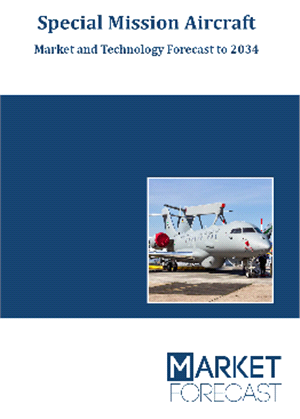
Special Mission Aircraft - Market and Technology Forecast to 2034
Special Mission Aircraft - Market and Technology Forecast to 2034
Market forecast by Region and Mission Type. Country and Programme Analysis, Market and Technology Overview, CRMs, Opportunity Analysis, and Leading Company Profiles
Market forecast by Region and Mission Type. Country and Programme Analysis, Market and Technology Overview, CRMs, Opportunity Analysis, and Leading Company Profiles
Military Special Mission Aircraft are a critical component of modern defence capability. They support intelligence collection, surveillance, reconnaissance, airborne early warning and control, maritime security, electronic warfare, communications and search-and-rescue operations. As armed forces prepare for increasingly contested, dispersed and data-intensive operations, demand is growing for aircraft capable of collecting, processing and distributing information across multiple operational domains.
This study provides an in-depth analysis of the global Military Special Mission Aircraft market through 2034. It covers (primarily) manned rotary and fixed-wing reconnaissance, maritime patrol, electronic warfare, airborne early warning and control, signals intelligence, communications and search-and-rescue aircraft. The study assesses technologies, research and development programmes, active inventories, procurement plans, recent contracts, market dynamics, regional forecasts, competitive positioning, supply-chain risks and future opportunities.
The global Military Special Mission Aircraft market is forecast to reach a cumulative value of approximately US$177.1 billion between 2026 and 2034, representing a compound annual growth rate of 7.2%. North America will remain the largest regional market, driven mainly by major United States reconnaissance, command-and-control, communications and maritime-patrol programmes. Europe and Asia-Pacific will also represent significant modernisation and replacement markets.
Demand is being shaped by ageing aircraft fleets, higher defence expenditure, deteriorating geopolitical conditions and the increasing operational value of information superiority. Maritime-security requirements, sovereign intelligence priorities and the proliferation of advanced air, missile and electronic threats are encouraging governments to strengthen airborne surveillance, battle-management and electronic-warfare capabilities.
Important market trends include the growing use of business-jet platforms, the adoption of open mission architectures and the transition from individual aircraft towards networked systems of systems. Buyers increasingly require aircraft that can exchange information with uncrewed systems, satellites, naval vessels and land-based sensors while performing several missions within a common platform.
Technology development is also transforming the market. Artificial intelligence, automated sensor fusion, cognitive electronic warfare, next-generation active electronically scanned array radar, edge processing and resilient communications are becoming central to future requirements. Modular payloads and software-defined mission systems will allow capabilities to be upgraded more rapidly and reduce dependence on complete aircraft replacement.
The competitive landscape is concentrated around a relatively small group of airframe manufacturers and mission-system integrators. Boeing has the largest share of the active global inventory, while Textron Aviation, Lockheed Martin, Northrop Grumman and Airbus also maintain important market positions. Bombardier and Gulfstream have smaller installed fleets but are increasingly prominent in high-value AEW&C, SIGINT, electronic-warfare and airborne-communications programmes. Dassault Aviation, Saab, Leonardo, Israel Aerospace Industries and other specialist suppliers also compete in selected mission segments.
The study highlights the growing importance of mission-system integration and through-life support. Future procurement decisions will not be based solely on aircraft performance. Governments increasingly require sovereign control of mission data, secure software architectures, domestic industrial participation, in-country maintenance, training, technology transfer and reliable access to spare parts and upgrades.
Supply-chain resilience is also becoming an important consideration. Critical raw materials, advanced electronics, radar components, semiconductors, engines and specialist integration capacity can create programme bottlenecks. Long qualification periods and dependence on a limited number of trusted suppliers increase cost, schedule and sovereignty risks for manufacturers and operators.
Covered in this study
- Special Mission Aircraft technologies and development programmes
- Reconnaissance, MPA, AEW&C, EW, SIGINT, COMMS and SAR segments
- Regional market forecasts to 2034
- Mission-type market forecasts to 2034
- Procurement programmes by country
- Inventory-replacement opportunities
- Active aircraft inventories and leading platforms
- Recent contracts and programme activity
- Main customers and procurement organisations
- Competitive landscape and leading company profiles
- Partnerships, industrial participation and market-entry strategies
- Supply-chain bottlenecks and sovereignty risks
- Critical raw materials used in Special Mission Aircraft
- Technology readiness and future capability trends
- Market drivers, trends, opportunities and challenges
Segmentation
The Military Special Mission Aircraft market is segmented by Region and Mission Type.Region
- North America
- Europe
- Asia-Pacific
- Middle East and Africa
- Latin America
Mission Type
- Reconnaissance
- Maritime Patrol Aircraft
- Electronic Warfare
- Airborne Early Warning and Control
- Signals Intelligence
- Communications
- Search and Rescue
Who will benefit from this report?
This study is designed for defence-industry executives, business-development teams, programme managers, aircraft manufacturers, mission-system integrators, sensor and communications suppliers, tier-one and tier-two companies, investors, consultants, policy makers, defence planners and government procurement organisations. It supports market-entry planning, opportunity identification, competitive assessment, technology monitoring, partnership development and long-term strategic decision-making in the Military Special Mission Aircraft sector.Related studies
- Military Air Transport - Market and Technology Forecast to 2034
- Military Helicopters - Market and Technology Forecast to 2034
- Combat Aircraft - Market and Technology Forecast to 2033
- Firefighting Aircraft - Market and Technology Forecast to 2032
- Military Unmanned Aerial Systems (UAS) - Market and Technology Forecast to 2032
- MALE and HALE UAV's - Market and Technology Forecast to 2031
- Electronic Warfare (EW) - Market and Technology Forecast to 2033
1.1 Special Aircraft market summary by Region
1.2 Special Aircraft market summary by Mission Type
2 Introduction
2.1 Scope
2.2 Methodology
2.3 Who will benefit from this study
3 Technologies and Development Programmes
3.1 Technologies of Research for Military Special Mission Aircraft
3.2 Research & Development Programmes
3.3 Technological developments in Russia and China
4 Critical Raw Materials
5 Market overview
5.1 Introduction
5.2 Main market players overview
5.3 Active inventory
5.4 Leading products
5.4.1 Boeing P-8A Poseidon
5.4.2 Saab GlobalEye
5.4.3 Boeing E-7 Wedgetail
5.4.4 Northrop Grumman E-2D Advanced Hawkeye
5.4.5 Airbus C295 MPA/ASW
5.4.6 Leonardo ATR 72MP
5.4.7 IAI ELW-2085 CAEW
5.4.8 L3Harris/BAE Systems EA-37B Compass Call
5.4.9 L3Harris MC-55A Peregrine
5.4.10 Beechcraft King Air 360ER
5.5 Recent contracts overview
5.6 Funding mechanisms
5.7 Main customers overview
5.8 Joint Ventures and Partnerships overview
5.9 Supply Chain overview (Including market shares)
6 Procurement Programmes Overview by Country
6.1 Canada
6.2 United States
6.3 Belgium
6.4 Cyprus
6.5 Denmark
6.6 France
6.7 Germany
6.8 Italy
6.9 Netherlands
6.10 Norway
6.11 Poland
6.12 Spain
6.13 Sweden
6.14 Türkiye
6.15 United Kingdom
6.16 Other countries Europe
6.17 Australia
6.18 Brunei
6.19 India
6.20 Japan
6.21 Pakistan
6.22 Philippines
6.23 Singapore
6.24 South Korea
6.25 Thailand
6.26 Other countries APAC
6.27 Iraq
6.28 Israel
6.29 Qatar
6.30 Saudi Arabia
6.31 Other countries MEA
6.32 Argentina
6.33 Brazil
6.34 Panama
6.35 Peru
7 Market Dynamics
7.1 Market drivers
7.2 Market trends
7.3 Market opportunities
7.4 Market challenges
8 Market Segments & Forecast Notes
8.1 Segmentation Special Mission Aircraft Market
8.2 Forecast Factors and Notes
9 Special Mission Aircraft market to 2034 by Region
9.1 Special Mission Aircraft market by Region overview
9.2 Special Mission Aircraft market Region by Mission Type overview
9.2.1 North America market by Mission Type overview
9.2.2 Europe market by Mission Type overview
9.2.3 Asia-Pacific market by Mission Type overview
9.2.4 Middle-East & Africa market by Mission Type overview
9.2.5 Latin America market by Mission Type overview
10 Special Mission Aircraft market to 2034 by Mission Type
10.1 Special Mission Aircraft market by Mission Type overview
10.2 Special Mission Aircraft market Mission Type by Region overview
10.2.1 Airborne Early Warning and Control market by Region overview
10.2.2 Reconnaissance market by Region overview
10.2.3 Maritime Patrol Aircraft market by Region overview
10.2.4 Electronic Warfare market by Region overview
10.2.5 Search and Rescue market by Region overview
10.2.6 Communications market by Region overview
11 Opportunity Analysis
11.1 Introduction
11.2 Compound Growth Rates
11.2.1 By Region
11.2.2 By Mission Type
11.2.3 Region
11.2.4 Mission Type
11.3 Assessed and Emerging Opportunities
12 Companies
12.1 Airbus SE (Group)
12.1.1 Introduction
12.1.2 Special Mission Aircraft - Products and Services
12.1.3 Special Mission Aircraft - Recent Developments
12.1.4 Special Mission Aircraft - Recent Contracts
12.1.5 SWOT Analysis
12.2 Bombardier Inc.
12.2.1 Introduction
12.2.2 Special Mission Aircraft - Products and Services
12.2.3 Special Mission Aircraft - Recent Developments
12.2.4 Special Mission Aircraft - Recent Contracts
12.2.5 SWOT Analysis
12.3 Dassault Aviation
12.3.1 Introduction
12.3.2 Products and Services
12.4 General Dynamics Corporation
12.4.1 Introduction
12.4.2 Products and Services
12.5 Ilyushin
12.5.1 Introduction
12.5.2 Special Mission Aircraft - Products and Services
12.5.3 Special Mission Aircraft - Recent Developments
12.6 Israel Aerospace Industries (IAI)
12.6.1 Introduction
12.6.2 Special Mission Aircraft - Products and Services
12.6.3 Special Mission Aircraft - Recent Developments
12.6.4 SWOT Analysis
12.7 Leonardo S.p.A.
12.7.1 Introduction
12.7.2 Special Mission Aircraft - Products and Services
12.7.3 Special Mission Aircraft - Recent Developments
12.7.4 Special Mission Aircraft - Recent Contracts
12.7.5 SWOT Analysis
12.8 Lockheed Martin Corporation
12.8.1 Introduction
12.8.2 Special Mission Aircraft - Products and Services
12.8.3 Special Mission Aircraft - Recent Developments
12.8.4 Special Mission Aircraft - Recent Contracts
12.8.5 SWOT Analysis
12.9 Northrop Grumman Corporation
12.9.1 Introduction
12.9.2 Special Mission Aircraft - Products and Services
12.9.3 Special Mission Aircraft - Recent Developments
12.9.4 Special Mission Aircraft - Recent Contracts
12.9.5 SWOT Analysis
12.10 Pilatus Aircraft Ltd.
12.10.1 Introduction
12.10.2 Products and Services
12.11 Saab AB
12.11.1 Introduction
12.11.2 Special Mission Aircraft - Products and Services
12.11.3 Special Mission Aircraft - Recent Developments
12.11.4 Special Mission Aircraft - Recent Contracts
12.11.5 SWOT Analysis
12.12 Textron Aviation Inc.
12.12.1 Introduction
12.12.2 Special Mission Aircraft - Products and Services
12.12.3 Special Mission Aircraft - Recent Developments
12.12.4 Special Mission Aircraft - Recent Contracts
12.12.5 SWOT Analysis
12.13 The Boeing Company
12.13.1 Introduction
12.13.2 Special Mission Aircraft - Products and Services
12.13.3 Special Mission Aircraft - Recent Developments
12.13.4 Special Mission Aircraft - Recent Contracts
12.13.5 SWOT Analysis
13 Results and Conclusions
14 About Market Forecast
14.1 General
14.2 Contact us
14.3 Disclaimer
14.4 License
Appendix A: Companies Mentioned
Appendix B: Abbreviations
List of figures
Figure 1: Study ElementsFigure 2: Proprietary System for Data Structuring
Figure 3: Y-9 anti-submarine patrol aircraft (2026)
Figure 4: Critical Raw Materials producing countries
Figure 5: Critical Raw Materials dependence [%] and volume [mt] by producing countries
Figure 6: Competition layers military Special Mission Aircraft market
Figure 7: Market volumes over the forecast period per region
Figure 8: Top 10 countries active inventory Special Mission Aircraft per type
Figure 9: P-8A Poseidon
Figure 10: GlobalEye
Figure 11: E-7 Wedgetail
Figure 12: E-2D Advanced Hawkeye
Figure 13: C295 MPA
Figure 14: ATR 72MP
Figure 15: ELW-2085 CAEW
Figure 16: EA-37B Compass Call
Figure 17: MC-55A Peregrine
Figure 18: King Air 360ER
Figure 19: Segmentation Special Mission Aircraft market
Figure 20: Special Mission Aircraft market to 2034 by Region [US$ millions]
Figure 21: Special Mission Aircraft market to 2034 by Region %
Figure 22: North America Special Mission Aircraft market to 2034 by Mission Type
Figure 23: North America - Special Mission Aircraft market to 2034 by Mission Type
Figure 24: Europe Special Mission Aircraft market to 2034 by Mission Type
Figure 25: Europe - Special Mission Aircraft market to 2034 by Mission Type
Figure 26: Asia-Pacific Special Mission Aircraft market to 2034 by Mission Type
Figure 27: Asia-Pacific - Special Mission Aircraft market to 2034 by Mission Type
Figure 28: Middle-East & Africa Special Mission Aircraft market to 2034 by Mission Type
Figure 29: Middle-East & Africa - Special Mission Aircraft market to 2034 by Mission Type
Figure 30: Latin America Special Mission Aircraft market to 2034 by Mission Type
Figure 31: Latin America - Special Mission Aircraft market to 2034 by Mission Type
Figure 32: Special Mission Aircraft market to 2034 by Mission Type [US$ millions]
Figure 33: Special Mission Aircraft market to 2034 by Mission Type %
Figure 34: Airborne Early Warning and Control Special Mission Aircraft market to 2034 by Region
Figure 35: Airborne Early Warning and Control - Special Mission Aircraft market to 2034 by Region
Figure 36: Reconnaissance Special Mission Aircraft market to 2034 by Region
Figure 37: Reconnaissance - Special Mission Aircraft market to 2034 by Region
Figure 38: Maritime Patrol Aircraft Special Mission Aircraft market to 2034 by Region
Figure 39: Maritime Patrol Aircraft - Special Mission Aircraft market to 2034 by Region
Figure 40: Electronic Warfare Special Mission Aircraft market to 2034 by Region
Figure 41: Electronic Warfare - Special Mission Aircraft market to 2034 by Region
Figure 42: Search and Rescue Special Mission Aircraft market to 2034 by Region
Figure 43: Search and Rescue - Special Mission Aircraft market to 2034 by Region
Figure 44: Communications Special Mission Aircraft market to 2034 by Region
Figure 45: Communications - Special Mission Aircraft market to 2034 by Region
Figure 46: Special Mission Aircraft Size by Region
Figure 47: Special Mission Aircraft CAGR by Region
Figure 48: Special Mission Aircraft Size by Mission Type
Figure 49: Special Mission Aircraft CAGR by Mission Type
Figure 50: Opportunities in the Military Special Mission Aircraft market to 2034 by Region [U$S millions]
Figure 51: Assessed and Inventory-replacement based opportunities for the Special Mission Aircraft market to 2034 by Region [U$S millions]
Figure 52: Assessed and Inventory-replacement based opportunities for the Special Mission Aircraft market 2026-2034 period by Aircraft Type [U$S millions]
Figure 53: Years past service life of SMA (last-first year introduced)
List of tables
Table 1: Critical Raw Materials used in Special Mission AircraftTable 2: Critical Raw Materials - Annual production from low-risk countries (LRC) versus required production for Special Mission Aircraft
Table 3: Market characteristics by segment
Table 4: Leading companies in the Special Mission Aircraft market
Table 5: Roles and structure of the customer base
Table 6: Major Buying Organisations
Table 7: Partnerships, joint ventures and industrial cooperation
Table 8: Acquisitions, investments and portfolio restructuring
Table 9: Tier structure
Table 10: Special Mission Aircraft - Cumulative Procurement Programmes Share by Country
Table 11: Special Mission Aircraft market to 2034 by Region [US$ millions]
Table 12: North America Special Mission Aircraft market to 2034 by Mission Type [US$ millions]
Table 13: Europe Special Mission Aircraft market to 2034 by Mission Type [US$ millions]
Table 14: Asia-Pacific Special Mission Aircraft market to 2034 by Mission Type [US$ millions]
Table 15: Middle-East & Africa Special Mission Aircraft market to 2034 by Mission Type [US$ millions]
Table 16: Latin America Special Mission Aircraft market to 2034 by Mission Type [US$ millions]
Table 17: Special Mission Aircraft market to 2034 by Mission Type [US$ millions]
Table 18: Airborne Early Warning and Control Special Mission Aircraft market to 2034 by Region [US$ millions]
Table 19: Reconnaissance Special Mission Aircraft market to 2034 by Region [US$ millions]
Table 20: Maritime Patrol Aircraft Special Mission Aircraft market to 2034 by Region [US$ millions]
Table 21: Electronic Warfare Special Mission Aircraft market to 2034 by Region [US$ millions]
Table 22: Search and Rescue Special Mission Aircraft market to 2034 by Region [US$ millions]
Table 23: Communications Special Mission Aircraft market to 2034 by Region [US$ millions]
Table 24: Assessed programmes with potential opportunities
Aechelon Technology, Inc.
Air Industries Group
Airbus Defence and Space
Airbus Helicopters
Airbus SE (Group)
Amentum
BAE Systems Australia
BAE Systems Plc
Bell Textron Inc.
Bombardier Inc.
CAE Inc.
CAES (Cobham Advanced Electronic Solutions)
Collins Aerospace
Conair Group Inc.
Curtiss-Wright Defense Solutions
Dassault Aviation
Defence Research & Development Organisation (DRDO)
Defense Security Cooperation Agency (DSCA)
Derco Aerospace
Elbit Systems Ltd.
Embraer S.A.
Embraer-CAE
Field Aerospace
Fokker Services
GE Aerospace
General Atomics
General Dynamics Corporation
Gulfstream Aerospace Corporation
Hanwha Aerospace
Hensoldt AG
Honeywell Aerospace
ILIAS Solutions
Ilyushin
Indra Sistemas, S.A.
Israel Aerospace Industries (IAI)
KBR
Kawasaki Heavy Industries
Korea Aerospace Industries - KAI
L3Harris MAS Inc.
L3Harris Technologies
LIG Nex1
Leidos
Leonardo DRS
Leonardo S.p.A.
Leonardo UK
Lockheed Martin Corporation
Lufthansa Technik AG
Marshall Group
Mercury Systems
Moog Inc.
Northrop Grumman Corporation
PT Dirgantara Indonesia (PTDI)
Pilatus Aircraft Ltd.
Polaris Sales Australia Pty Ltd
Pratt & Whitney
Principle Finance Pty Limited
QinetiQ
QinetiQ North America
Raytheon
Rheinmetall AG
Rolls-Royce
ST Engineering
Saab AB
Sabena Engineering
Safran S.A.
Shaanxi Aircraft Corporation / AVIC
Sierra Nevada Corporation
Sikorsky Aircraft Corporation
TT Electronics plc
Textron Aviation Inc.
Textron Inc.
Textron Systems
Thales
The Boeing Company
Turkish Aerospace Industries
Viasat, Inc.
Single User License: This license allows for use of a report by one person. This person may use the report on any computer, and may print out the report, but may not share the report (or any information contained therein) with any other person or persons. Unless a Departmental License, a Site License or a Global Site License is purchased, a Single User License must be purchased for every person that wishes to use the report within the same enterprise. Customers who infringe these license terms are liable for a Global Site license fee.
5-User License: This license allows for use of a report by five people within the same enterprise. Each of these people may use the report on any computer, and may print out the report, but may not share the report (or any information contained therein) with any other person or persons. Customers who infringe these license terms are liable for a Global Site license fee.
Site License: This license allows for use of a report by an unlimited number of people within the same enterprise location. Each of these people may use the report on any computer, and may print out the report, but may not share the report (or any information contained therein) with any person or persons outside of the enterprise location. Customers who infringe these license terms are liable for a Global Site license fee.
Enterprise License: This license allows for use of a report by an unlimited number of people within the same enterprise worldwide. Each of these people may use the report on any computer, and may print out the report, but may not share the report (or any information contained therein) with any other person or persons outside of the enterprise.
| Study Code: | MF263094 |
| Publication date: | August 14, 2026 |
| Pages: | 216 |