The Growing Strategic Impact of AI-Powered One-Way Attack Drones
Amsterdam, NL - September 28, 2026 -
The concept of drone swarms is moving from experimental status into operational reality. A true swarm is defined by collaborative behaviour: continuous information exchange between platforms, dynamic route adjustment, shared search responsibilities and automatic redistribution of tasks when individual systems are lost. This differs fundamentally from the mass launch of independent one-way attack drones, which remain the dominant current method of saturation strike.
Recent battlefield developments highlight this shift. Systems equipped with advanced onboard processing can now identify and engage targets with minimal to no continuous human oversight once inside a designated area. This level of coordination is driven by parallel breakthroughs in machine vision, automated target recognition, electronic-warfare-resistant navigation, and multi-platform mesh networking.
Field deployments and military exercises routinely show small drone groups dividing search sectors, sharing sensor telemetry, and relaying targeting and tracking data back to operators. The core technological milestone is not the simultaneous flight of multiple platforms, but rather the underlying software architecture that allows these formations to scale seamlessly from small teams to dozens or hundreds of synchronised systems. In response to this evolving threat, militaries are also deploying autonomous interceptors to automate the detection-to-engagement loop against incoming one-way attack systems.
Industry activity reflects the same direction. Several companies are developing AI platforms that enable drones to operate with limited communications and to coordinate within a swarm. Contracts have been awarded for multi-drone control systems, resilient communications architectures and AI-enabled one-way attack kits. Government research programmes continue to fund decentralised coordination algorithms intended to support heterogeneous groups of unmanned systems in contested environments.
Global powers are advancing these capabilities at varying speeds. Current engineering focus centres on single-operator control over massive fleets, algorithms that maintain formation cohesion under heavy electronic jamming, and airborne carrier platforms designed to launch clusters of smaller sub-munitions. These initiatives stem from a clear reality: individual drones are highly vulnerable to modern air defences, whereas synchronised groups can systematically overwhelm interceptors through sheer mass and adaptive, decentralised tactics.
The strategic implications are profound. In an operational environment where a high percentage of isolated drones are neutralised, the capacity to deploy coordinated, semi-autonomous or fully autonomous groups fundamentally alters the cost-exchange dynamic and force planning. Even as international regulatory debates over lethal autonomous weapons systems (LAWS) drag on, R&D programs among leading military states continue to accelerate.
Ultimately, the realisation of true autonomous swarming is an incremental process driven by the convergence of several maturing technologies. As standalone breakthroughs in navigation, machine vision, automated target recognition, secure communications, and collaborative software merge, the defence sector is shifting decisively away from independent one-way attack drones toward fully synchronised, multi-platform operations.
Operational experience is reinforcing this direction. The U.S. Low-Cost Uncrewed Combat Attack System (LUCAS), a long-range one-way attack drone, is being equipped with Shield AI’s Hivemind autonomy software to enable collaborative swarm employment. Once integrated, groups of LUCAS platforms will be able to coordinate, manoeuvre and adapt to changing conditions in real time under the supervision of a single operator. Autonomy manages navigation, formation flying, obstacle avoidance and dynamic re-routing, while human operators retain authority over strike decisions. This approach converts affordable mass into coordinated mass, allowing multiple low-cost effectors to operate as a resilient team in communications-constrained and contested environments. An operational demonstration of the swarm capability is planned.
The commercial technology base plays an equally critical role in this evolution. Dual-use computing modules, originally engineered for commercial development and educational purposes, are now frequently recovered from operational military hardware. This trend underscores the immense difficulty of restricting access to advanced processing units within a highly globalised supply chain.
Consequently, the strategic trajectory remains clear. In a threat landscape where a high percentage of isolated drones can be intercepted, the ability to field large, resilient, and adaptive groups fundamentally alters the cost-exchange dynamic and upends traditional defensive planning. As a result, this collaborative capability is fast becoming the primary catalyst shaping the future market demand for one-way attack systems.
More insights on One-Way Attack Drones and other defence market and technology studies are available on the MF Intelligencebase platform.
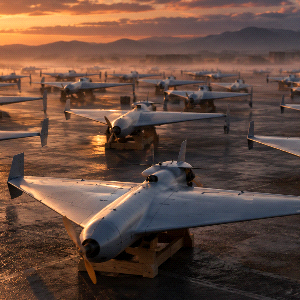
LUCAS II
Related Studies