C-UAS Interceptors Emerging as the New Battlefield Shield
Amsterdam, NL - September 21, 2026 -
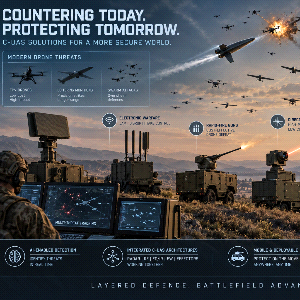
Recent conflicts across multiple regions are demonstrating that modern warfare is increasingly being shaped by the ability to detect, disrupt, and neutralise unmanned aerial threats at scale. From low-cost FPV drones and loitering munitions to coordinated swarm attacks, unmanned systems are rapidly transforming battlefield dynamics and forcing militaries worldwide to rethink traditional air defence strategies. As a result, Counter-Unmanned Aerial Systems (C-UAS) and interceptor technologies are emerging as critical pillars of future military operations.
Recent battlefield developments, particularly during the Russia-Ukraine War and ongoing conflicts in the Middle East, have highlighted the growing operational impact of drones on modern combat environments. Adversaries are increasingly deploying large numbers of inexpensive drones for reconnaissance, electronic warfare, precision strikes, and swarm attacks designed to overwhelm conventional air defence systems. These developments are accelerating demand for layered counter-drone architectures capable of responding rapidly and economically to persistent aerial threats.
The evolving threat landscape has also transformed the role of interceptor systems. Traditional surface-to-air missiles, while effective, are often economically unsustainable against low-cost drone attacks. In response, militaries are prioritising low-cost interceptors, electronic warfare systems, rapid-fire guns, and directed energy weapons designed specifically for counter-drone operations. Interceptor drones are increasingly being viewed as the “new battlefield shield,” providing scalable and cost-effective protection against swarm-based attacks and low-altitude threats.
Another defining trend is the increasing integration of artificial intelligence (AI), electronic warfare (EW), and network-centric command-and-control systems within modern C-UAS architectures. Counter-drone systems are evolving into highly integrated ecosystems where radar, RF detection, electro-optical tracking, interceptors, and jamming systems operate together in real time. AI-enabled detection and autonomous targeting are becoming critical for identifying and neutralising multiple fast-moving drone threats simultaneously, particularly in dense and contested operational environments.
The widespread adoption of unmanned systems has further intensified the need for rapid-response and mobile counter-drone capabilities. Modern military operations increasingly require deployable and vehicle-mounted C-UAS platforms capable of protecting manoeuvring forces, airbases, naval assets, and critical infrastructure. Programmes focused on low-cost effectors, mobile interceptors, and directed energy weapons are now becoming central to future defence planning across Europe, the Middle East, the Indo-Pacific, and North America.
The global military C-UAS market is therefore entering a period of accelerated transformation, driven by evolving warfare doctrines, technological innovation, and rising geopolitical tensions. As drone threats continue to expand in scale, autonomy, and operational sophistication, future battlefield superiority will increasingly depend on the ability to deploy layered, AI-enabled, and economically sustainable counter-drone defence systems.
More insights on Counter-UAS Systems and other defence market and technology studies are available on the MF Intelligencebase platform.
Related Studies