USMC Selects GA-ASI for MUX TACAIR Collaborative Combat Aircraft Program
February 10, 2026
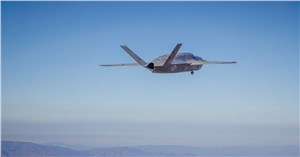
-General Atomics Aeronautical Systems, Inc. (GA-ASI) was competitively selected by the U.S. Marine Corps (USMC) for evaluation in the Marine Air-Ground Task Force Uncrewed Expeditionary Tactical Aircraft (MUX TACAIR) Collaborative Combat Aircraft (CCA) program. The agreement integrates GA-ASI’s expertise in autonomy and uncrewed aircraft systems with a government-provided mission package, using the YFQ-42A platform as a surrogate to evaluate integration with crewed fighters.
The contract initiates integration of a Marine Corps mission kit into the YFQ-42A surrogate platform for assessment within the Marine Air Ground Task Force (MAGTF).
The USMC contract includes the rapid development of autonomy for the government-supplied mission kit — a cost-effective, sensor-rich, software-defined suite capable of delivering kinetic and non-kinetic effects — positioning the solution for use in expeditionary operations. This work will support evaluations of future MUX TACAIR capabilities.
“This selection builds upon the GA-ASI autonomous systems in use today and demonstrates our commitment to delivering next generation capabilities for critical USMC missions,” said Mike Atwood, Vice President of Advanced Programs for GA-ASI. “Our FQ-42, combined with our proven autonomy architecture and integration expertise, positions us to rapidly deliver an affordable CCA solution that enhances the Marine Air-Ground Task Force’s operational effectiveness in contested environments.”
GA-ASI was selected by the U.S. Air Force in April 2024 to build production-representative flight test articles for the CCA program. The YFQ-42A successfully conducted its maiden flight in August 2025, validating a “genus/species” concept for rapid, modular, and low-cost uncrewed fighter aircraft development. This approach enables a common core aircraft design that can be rapidly adapted for different mission sets and service requirements.
The YFQ-42A is a purpose-built CCA platform developed as part of GA-ASI’s ongoing investment in next-generation autonomous combat aircraft. The aircraft’s modular design enables rapid integration of mission systems. GA-ASI’s autonomy architecture, demonstrated through multiple live flight tests, provides the foundation for human-machine teaming in complex combat scenarios.
Source : General Atomics