Scaling Next-Gen Command and Control from Prototype to Fight
April 10, 2026
-The modern battlefield demands speed, resilience, and seamless coordination. For too long, vital information has been fragmented across disconnected systems, relying on manual coordination that slows decision cycles and puts lives at risk. That era is ending.
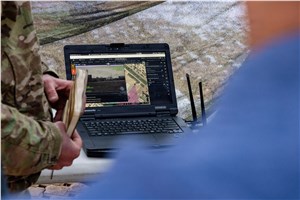
Since August 2025, Anduril, the Army’s 4th Infantry Division, and a team of industry partners have been building and testing a new approach to command and control that replaces those disconnected systems with a resilient network where sensor, vehicle, and command data are shared in real time, even under degraded conditions.
That effort has taken shape through five “Ivy Sting” exercises, a proving ground for the Army’s Next-Generation Command and Control (NGC2) prototype. Across these events, Anduril and our industry teammates deployed and refined new systems alongside Soldiers in operational conditions.
Each phase expanded the scope. Ivy Sting 1 focused on individual mission threads—linking a sensor to a decision or an effector. By Ivy Sting 4, those threads had scaled to more than 50 use cases executed across structured training lanes, including joint integration between Army and Marine Corps systems.
Ivy Sting 5 marked a shift from experimentation to integration at scale. In close partnership with the Army’s 4th Infantry Division, Team Anduril tripled the size of the NGC2 data mesh, tested it in austere environments, and demonstrated connectivity across services—concrete progress toward modernizing command and control for a contested battlefield.
Scaling Connectivity
Anduril deploys edge compute systems like Voyager to run Lattice and connected applications in austere environments. Each system—vehicles, command posts, units, or even individual Soldiers—becomes a node on Lattice Mesh, a distributed data layer where applications (common operating pictures, fires planning software, etc.) and sensors publish and subscribe to share information.
Scaling the mesh requires hardware. In February, Anduril accelerated production of Voyager edge compute systems, producing one fully configured system per hour and ultimately modernizing a brigade of combat vehicles in just 10 days in the lead-up to Ivy Sting 5. Once upgraded, the vehicles became nodes on the mesh, allowing critical data such as vehicle telemetry, logistics data, and target tracks to be shared automatically across formations.
While Voyager offers resilient computing at the edge, the broader goal is connectivity across the joint force. To do that, Anduril also deployed Lattice onto existing Army compute systems. During Ivy Sting 5, we onboarded main battle tanks and Stryker vehicles onto the network without replacing onboard hardware. Together, these efforts reduce the barriers to scaling connectivity across the Army.
A Data Mesh That Holds Under Pressure
Team Anduril tripled the size of the NGC2 data mesh during Ivy Sting 5, connecting 65+ tactical edge nodes to enable common access to 20+ applications, 25+ data feeds, and 25+ sensors and effectors. Distributed vehicles, command posts, and units operated from a shared picture of the battlespace, enabling Soldiers to coordinate and act even when parts of the network were degraded.
The Army put the performance of Lattice Mesh to the test in a degraded communications environment, eliminating satellite and commercial communications and severing a unit’s connectivity to higher headquarters during one phase of the exercise. Despite that, Lattice Mesh enabled the free flow of information locally, allowing the 4th Infantry Division to execute a full, end-to-end electronic warfare targeting and fires sequence.
Operating Across the Joint Fight
The modern battlefield demands joint operations. During Ivy Sting 5, warfighters leveraged Lattice Mesh to achieve the first complete sensor-to-effector kill chain across services and security domains without requiring manual data re-entry, a critical milestone that dramatically accelerates joint workflows.
In one scenario, a special operations unit identified a target and passed it digitally through the network to Army systems, where Lattice’s course-of-action generation software provided response options. A commander reviewed and selected a course of action before the target was digitally passed to a Marine Corps High Mobility Artillery Rocket System (HIMARS) unit for execution.
The entire sequence remained digital, with no manual re-entry between systems. Targeting timelines dropped from hours to minutes.
From Early Prototype to Fieldable Capability
Ivy Sting 5 showed an NGC2 ecosystem operating at scale. The 4th Infantry Division deployed, maintained, and used Lattice Mesh across larger scales and increasingly complex workflows, proving its ability to enable connectivity in comms-denied environments, magnify the capabilities of individual Soldiers, and accelerate cross-service workflows to streamline joint operations.
The focus now is less on whether the system works and more on how far it can scale. Ivy Mass will expand the network further ahead of the Army experimentation event, Project Convergence Capstone 6. These events will continue the trend: more units, more terrain, and more demanding conditions.
Anduril stands ready to deliver.
Source : Anduril Industries