NGC2 at Scale: How Team Anduril and the Army Took Lattice Across the 4th Infantry Division
May 21, 2026
-Connecting every soldier, sensor, weapon, and vehicle has been a long-standing Pentagon objective. Though efforts ranging from network-centric warfare to Joint All-Domain Command and Control (JADC2) advanced the concept over decades, achieving operational scale has remained the central challenge. Earlier systems often excelled in small tests, yet deploying their capabilities across entire units in demanding environments presented a profound technical and integration hurdle.
The Next-Generation Command and Control (NGC2) effort is the Army's answer to this challenge of operating at scale. Built on Anduril's Lattice Mesh, it's a modular, open architecture designed to connect soldiers, sensors, vehicles, and command posts into a shared data layer, even under degraded conditions.
At Ivy Mass, NGC2 expanded across the entire division. For the first time, the entire 4th Infantry Division (4ID), not just selected brigades and battalions, operated on the mesh. In April and May 2026, 4ID ran NGC2 across the formation, with soldiers operating the system themselves. Ivy Mass was the culmination of the Ivy Sting series, a progressive set of exercises that built NGC2 capability over the past year, and the final event before the Army's Project Convergence Capstone 6 (PCC6) this summer.
What Scale Looked Like at Ivy Mass
Every Soldier Becomes a Node. Until recently, nodes on the NGC2 mesh meant computers mounted in vehicles, command posts, and unmanned systems. Soldiers accessed the network through radios and vehicle screens, but weren't on the mesh themselves.
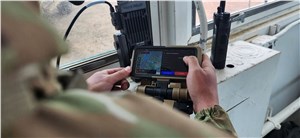
That changed when Team Anduril and the Army fielded Lattice on the tablets and end-user devices soldiers already carry. The number of connected soldier devices grew from ~10 at Ivy Sting 5 to >2,500 at Ivy Mass. Every soldier with a device became a node on the same data layer as command posts and weapon systems.
Doubling the Size of the Mesh. Beyond soldier devices, the tactical edge network itself expanded. Tactical Edge Computers (TECs), the deployable compute systems mounted in vehicles, command posts, and unmanned platforms that host Lattice in the field, grew from ~65 at Ivy Sting 5 to more than 130 at Ivy Mass. Each TEC extends the reach of the network further into the formation, putting compute closer to the soldiers and vehicles that depend on it.
More Applications, Faster. Scale also means expanding what the system can do. The value of NGC2 grows with every new application, sensor, and effector connected to it. At Ivy Mass, Team Anduril and the Army onboarded 17 new applications and 11 new sensors, bringing the totals to 40 applications, 36 data feeds, and 37 sensors and effectors across nine hardware form factors. Every new application connected to the mesh adds additional capabilities, from fires planning and sustainment to intelligence, sensor feeds, and course-of-action generation.
A Usable Mesh: Scaling Up While Stepping Back
A capability that scales is one the Army can run on its own. At Ivy Mass, the Army operated NGC2 at division scale and took over tasks that Anduril teams had led during earlier Ivy Sting exercises, including provisioning nodes, updating software, and integrating new systems onto the mesh.
The division's communications team brought every new TEC onto the network with Anduril's one-click peering function, giving each node access to the shared data layer. Fleet Manager, Anduril's tool for monitoring and updating software, gave soldiers a single interface to manage software health and push remote updates across all >2,500 end-user devices.
Ease of use mattered as much as technical scale. As Zach Kramer, the General Manager of Anduril’s Mission Command business line, said after Ivy Mass, the goal is to avoid systems that require retraining every time software changes: “These things need to feel native and intuitive.”
Most of the soldier feedback at Ivy Mass focused on usability, refining the experience of soldiers using NGC2 day-to-day rather than adding new capabilities. That feedback is driving the next round of changes, and it's what makes the system more valuable the more soldiers touch it.
Ownership also showed up in what soldiers built on top of NGC2. Because Lattice is built on a modular, open architecture, soldiers can develop and deploy their own applications on the same mesh that runs the rest of the division's tools. 4ID developed and deployed eight of their own plug-ins on Lattice. One soldier used AI coding tools to build Circle-X, a vehicle maintenance app that writes directly into the Army's enterprise logistics system, GCSS-Army. Circle-X is the first soldier-developed application to read and write to an enterprise business system.
What Comes Next
The exercise also marked a transition point for the broader NGC2 effort. Ivy Mass set the stage for PCC6, where, building on 4ID's accomplishments, the Army will demonstrate NGC2 to the wider force in joint and coalition scenarios.
A year ago, NGC2 was a prototype awarded under an Other Transaction Authority agreement. At Ivy Mass, the 4th Infantry Division ran it themselves — provisioning nodes, building their own apps, and operating a network they could manage and maintain independently. Ivy Mass showed that NGC2 is no longer just a prototype delivered to soldiers; it is becoming infrastructure the division can operate, adapt, and expand on its own.
Source : Anduril Industries