Indra Participates in the Development of the Advanced Communications Terminal That Will Strengthen the Interoperability of European Fighter Aircraft
July 21, 2026
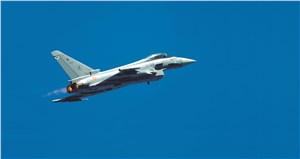
-The EuroMIDS SAS consortium, comprising Hensoldt Sensors, Indra Group, Leonardo and THALES SIX GTS France, has signed a contract with the Organisation for Joint Armament Cooperation (OCCAR) to promote the EMIDS-2 programme, which will develop the F-EMIDS communications terminal. This terminal will provide European combat aircraft with the interoperability and advanced capabilities they will need in the coming years to exchange data continuously and in real time.
This terminal will replace the current systems based on Link 16 data links carried by fighter aircraft such as the Eurofighter, Rafale and Tornado IDS/ECR, as well as the A400M military transport aircraft and the E-3F AWACS early warning aircraft.
The development of the new system is decisive to ensure technological sovereignty over a critical defence element, within the reach of only a very small number of military powers.
Indra will thus gain knowledge and experience in the development of a next-generation communications terminal of vital importance in any military operation, while strengthening its position and leadership in the development of the combat cloud, as this will be one of the elements it comprises.
Within the EMIDS-2 programme, Indra will work on the development of the F-EMIDS A.0 terminal model, which will validate the system’s software and new communications capabilities, and on the F-EMIDS B.0 terminal, the first physical prototype, which will feature segregated red/black processing for handling classified information.
The key features of EMIDS systems include their new dual cryptographic architecture, which strengthens communications protection; the two waveforms, which allow aircraft to participate simultaneously in several networks (CMN, Concurrent Multi-Netting) and receive more data in saturated environments (CCR, Concurrent Contention Receive); and the new broadband ESSOR waveform, which is more secure, adapted to the needs of today’s theatres of operation and based on shared standards that facilitate interoperability.
At the same time, the software-defined radio architecture of these terminals provides the flexibility to adapt to the frequencies, modulations and standards required at any given time through software updates, rather than having to undertake costly hardware replacements as has been necessary until now. The EMIDS-2 programme builds on the first phase of the programme, which defined the ESSOR MIDS family of terminals, comprising F-EMIDS for combat aircraft, H-EMIDS for helicopters, M-EMIDS for naval platforms and S-EMIDS for land surface terminals.
Source : Indra