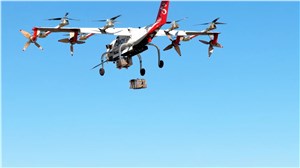
Elroy Air Equips Chaparral With 2 Unattended Delivery Modes Under US Army Contract
July 29, 2026
-Elroy Air, a leading U.S.-based technology developer of autonomous heavy-cargo drones for defense, rapid response and commercial logistics, today announced that the company has created three new unattended delivery modes for its Chaparral drone, developed under contract with the U.S. Army. Chaparral can now deliver payloads three ways: precision airdrop from a hover, precision airdrop in forward flight, and ground delivery, each executed without personnel or ground infrastructure at the receiving site.
In a demonstration at the company's Byron, California headquarters on July 15, 2026, Chaparral completed two payload releases in a single flight: a 68-pound payload drop from a close-in hover and a 70-pound payload release from 65 feet in forward flight. Both deliveries were software-commanded from pre-programmed coordinates, with no operator input during execution, a requirement for communications-denied environments. Neither drop required personnel at the delivery point. Elroy Air separately demonstrated ground delivery without attending personnel, in which the aircraft released its payload after landing.
"The Army asked us for these unattended delivery capabilities, and we developed them on time and on budget in a single autonomous aircraft. That's real capability for the warfighter, and it carries straight over to our commercial customers as well," said Andrew Clare, CEO of Elroy Air. “Next we will begin testing in the field alongside the U.S. Army in exercises designed to rapidly put these capabilities into the hands of our soldiers.”
The Chaparral was designed for multi-mission flexibility, with swappable cargo pods that allow a single aircraft to support different missions without airframe reconfiguration, runway or ground infrastructure, or delivery equipment or personnel. The aircraft can release cargo from hover for precision placement, in forward flight when speed or altitude must be maintained, or on the ground when conditions permit. The capability supports missions where landing is not possible or would reveal a position, including contested environments, disaster response, maritime operations, and austere terrain.
Aerial resupply is a critical capability for Army logistics. Unattended delivery from a runway-independent vertical-takeoff-and-landing (“VTOL”) platform gives commanders a way to sustain distributed operations without putting aircrews at risk, a priority reflected in the Army's growing investment in autonomous and contested logistics.
"Contested logistics is one of the hardest problems the joint force faces, from maritime resupply to sustaining distributed forces far from established hubs," said Mark Rodrigo, who leads Federal Business Development at Elroy Air and served as a U.S. Air Force intelligence officer supporting ISR operations across five continents. "One Chaparral can now resupply multiple positions in a single sortie, with no pilot at risk and no personnel required at the drop point. That's a force multiplier for units operating at the tactical edge."
These new delivery modes will be available on production Chaparral aircraft, which will be manufactured by Kratos Defense & Security Solutions (Nasdaq: KTOS) (“Kratos”) under Kratos and Elroy Air’s U.S. manufacturing partnership. On July 20, 2026, Kratos announced that it will manufacture Elroy Air's Chaparral autonomous cargo aircraft in its expanding Sacramento, California production facility.
Source : Elroy Air