Collaborating With Advanced Airborne Autonomy, the New Paradigm for Land Operations
June 08, 2026
-In the rapidly evolving landscape of modern conflict, the ability to maintain a decisive edge depends on more than just firepower—it hinges on speed, precision, and the seamless integration of intelligence and action. Distributed airborne autonomy is transforming land warfare by enabling uncrewed systems to operate alongside crewed assets, sharing critical data in real time while extending operational reach far beyond traditional front lines. Thales is at the forefront of this revolution, combining advanced autonomy, resilient networking, and multi-mission payloads to deliver effect at the edge. Discover how we are turning complexity into dominance for today’s armed forces.
Modern military operations face critical challenges: protecting personnel in high-risk environments, maintaining persistent surveillance over large areas, and ensuring real-time data sharing in electromagnetically contested spaces. Distributed airborne autonomy addresses these challenges by creating an intelligent, interconnected battlespace where uncrewed systems, artificial intelligence, and advanced sensors operate in perfect synchronization to provide an unmatched operational advantage.
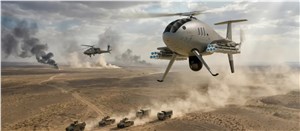
Advanced rotary-wing UAS can remain airborne for extended periods, conducting deep intelligence, surveillance, and reconnaissance missions far behind enemy lines. This persistent overwatch capability significantly reduces the need to expose personnel to dangerous environments while ensuring continuous flow of critical information to decision-makers.
The true revolution lies in the networking of the battlespace.
By seamlessly integrating uncrewed platforms with crewed assets—including attack helicopters, ground units, and command centres—forces achieve unprecedented levels of shared situational awareness. This real-time data fusion is crucial for outmanoeuvring adversaries, particularly in denied or contested environments where traditional communications may be compromised. The result is a unified operational picture that enables faster, more coordinated responses across the entire force.
Most significantly, distributed autonomy transforms passive observation into active engagement. Today's autonomous systems don't just sense the battlefield—they can execute precision strikes, employ electronic warfare measures, and deploy air-launched effects with minimal human intervention. This capability ensures that tactical decisions are not only made faster but are executed with greater precision, fundamentally enhancing mission success rates in the most demanding combat scenarios. However, the true power of these systems lies not just in their individual capabilities but in how they are integrated, teamed, and continuously evolved to meet the demands of modern warfare. This is where Thales excels.
Multi-Mission Rotary Wing UAS (RWUAS): The Foundation of Distributed Operations
Thales does not merely provide components or standalone systems; we deliver comprehensive, end-to-end warfighting solutions that are specifically designed to meet the complex and evolving needs of land operations. Our deep expertise in sensors, autonomy, and systems integration—combined with strategic partnerships with industry leaders like Schiebel—enables us to offer forces a true force multiplier. Thales integrates sensors (communication, navigation and avionics, electronic warfare), effectors (rockets, missiles, MTO) and battlespace networks into a seamless mesh that ensures that threats are neutralized before they can act. The Schiebel S-300, designed to carry multiple payloads simultaneously, equipped with Thales’ advanced I-Master or AirMaster C radar systems, along with electronic warfare systems, can detect, classify, and track targets with unparalleled accuracy. Additionally, its electro-optical and infrared (EO/IR) sensors ensure that operators have a clear and persistent view of the battlefield, regardless of environmental conditions. This multi-sensor approach guarantees that no threat goes undetected, providing forces with the intelligence they need to act decisively.
Once threats are identified by sensors designed to operate in the most challenging conditions, the ISTAR Node Edge Processor takes over, autonomously fusing data from multiple sources at the tactical edge. This advanced processing capability ensures that operators have a single, coherent picture of the battlefield, enabling them to make informed decisions quickly and confidently. It also enables the UAS to continue on its mission if its link to human operators is denied and degraded during flight. By bringing AI-driven analysis to the edge, Thales reduces the reliance on centralized command structures, allowing forces to respond to threats in real time.
Autonomy in military systems is not about replacing human decision-makers; it is about augmenting their capabilities with machine-speed processing and adaptive learning. Thales’ cortAIx autonomy stack represents a significant leap forward in this area, providing forces with the tools they need to operate more effectively in complex and dynamic environments. This advanced system enables "commanded, not controlled" operations where operators define mission intent while the autonomous system handles execution, dramatically reducing cognitive workload and accelerating response times.
No military system operates in isolation, and Thales understands that the true power of distributed airborne autonomy lies in its ability to integrate seamlessly with existing and future platforms. Our solutions are designed to interoperate with national command systems, allied coalition frameworks, and a wide range of crewed and uncrewed assets, ensuring that every element of the battlefield is connected and coordinated. Thales empowers forces to fight as one, leveraging the strengths of every asset to achieve mission success.
The Future of Land Warfare is Autonomous
Distributed airborne autonomy is more than just a technological advancement; it is a strategic shift in how land warfare is conducted. By combining persistence, precision, and collaborative intelligence, Thales is enabling forces to see deeper, decide faster, and strike smarter—anywhere on the battlefield.
As the operational environment continues to evolve, the need for integrated, networked, and autonomous solutions will only grow.
"With Thales, armed forces gain more than just a system—they gain a strategic partner committed to delivering the capabilities they need to succeed in the battles of today and tomorrow." Andrew Humphries - Product Line Manager, ISR Systems
Source : Thales