AI on the Front Line: Revolutionising Military Command and Control
July 23, 2026
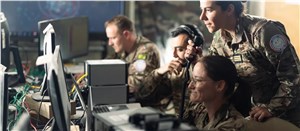
-Recent large-scale conflicts, such as those in Ukraine and Iran, have confirmed that the tempo of conventional warfare is steadily increasing. Time has now become a critical risk factor. In command-and-control (C2) centres, artificial intelligence is fast becoming an essential strategic asset to maintain operational superiority. Armed forces must understand an ever-changing tactical environment by harnessing the vast volumes of data now available, while planning and acting faster than the adversary.
Tacticos for naval combat management, SkyView for air operations and Atlas for land forces are among the solutions designed and marketed by Thales, specifically dedicated to military command and control. They enable military operations to be prepared and conducted with both precision and agility.
The start of testing this year for a new generation of Thales data-centric C2 systems marks a decisive step towards deploying AI on a broader scale. Designed from the outset to embed this technology at their core, these systems cover the entire operational chain, from data exploitation to decision support.
Easing cognitive load to accelerate action
"AI will help personnel responsible for command and control synthesise information and make the right decisions, ultimately enabling them to act faster than the adversary" Cyrille Guétin - Technical Director at Thales
“Given the density and diversity of sensors and effectors, the cognitive burden on command-and-control teams has become extremely high. AI will help them synthesise information and make the right decisions, ultimately enabling them to act faster than the adversary,” summarises Cyrille Guétin, Technical Director at Thales and co-author of the position paper Artificial Intelligence for Command-and-Control Centres.
AI’s primary contribution to C2 lies in its ability to transform vast quantities of heterogeneous data into immediately actionable information. Sources, whether text, images, video, audio, radar and sonar signals, are numerous, often incomplete, sometimes imprecise and difficult to interpret using conventional statistical approaches.
AI-enabled software helps create a comprehensive, up-to-date tactical situation picture. This forms the basis for decision-making by consolidating detections from sensors and information exchanged between units. It helps operators anticipate adversary movements and optimise the deployment of intelligence-gathering assets, including drone swarms. By analysing large volumes of data over extended periods, AI can detect patterns of activity, identify weak signals, reveal correlations that would otherwise be difficult to discern, and help operators understand how a threat is evolving.
AI can provide a visual overview of the situation and suggest potential courses of action. These may take the form of immediate tactical adjustments, plans overlaid on an operational map, or recommendations designed to inform command decisions. In a battlespace where the OODA loop — observe, orient, decide, act — is becoming ever shorter, the priority is to provide a concise, reliable and continuously updated understanding of the situation.
Deception, data poisoning and cyber threats: strengthening AI robustness
While the emergence of AI in command and control is set to transform military operations, it also exposes C2 systems to new vulnerabilities. Like humans, AI can be deceived. Alongside conventional decoys — such as a fake military site featuring inflatable tank mock-ups, which may mislead an AI system just as easily as a human observer — deception may involve poisoning the data used to train the system or inserting digital decoys into intelligence data feeds.
“It is very easy to create a deepfake and circulate it on social media in order to direct an adversary towards a fictitious target,” explains Katarzyna Kapusta, a cybersecurity expert and co-author of the position paper.
To address these risks, Thales has assembled a team of “friendly hackers”, involved both during the design of its systems and throughout their evaluation. The team has developed BattleBox, a library bringing together dedicated offensive and defensive tools, including deepfake detectors and mechanisms for identifying backdoors within AI models.
“One way of countering these attacks is to monitor the AI system and its behaviour against predefined rules, while also ensuring that the decisions it makes can be explained,” adds Katarzyna Kapusta.
Developing AI systems that are not only high-performing, but also reliable, resilient to attack, resource-efficient and integrated in a way that ensures strict human oversight, requires a specific technological approach. This is the kind of AI that Thales is developing for its command-and-control systems.
Source : Thales