Winning the Spectrum: Tactical Communications in Contested Warfare
Amsterdam, NL - August 24, 2026 -
Recent conflicts across multiple regions are demonstrating that modern warfare is increasingly defined not only by firepower and advanced platforms, but by the ability to secure, maintain, and dominate communications in contested electromagnetic environments. From large-scale electronic warfare operations to the disruption of battlefield networks, tactical communication systems are emerging as a critical determinant of operational success at the frontline.
Recent battlefield developments, particularly in high-intensity conflicts, have highlighted how electronic warfare (EW) and spectrum denial strategies are being used to degrade enemy communications, disrupt coordination, and isolate units. Jamming of radio networks, interception of communication signals, and spoofing of navigation and data links are now routine elements of modern combat. In response, forces are increasingly relying on resilient, frequency-agile, and software-defined communication systems capable of operating under constant electromagnetic pressure.
The conflict environment has also underscored the growing importance of secure and adaptive tactical networks. Traditional voice-based radios are being replaced by software-defined radios (SDRs) and IP-based communication architectures, enabling forces to dynamically switch frequencies, waveforms, and communication paths in real time. These systems allow units to maintain connectivity even when primary communication channels are degraded or denied, ensuring continuity of operations across dispersed and fast-moving battlefields.
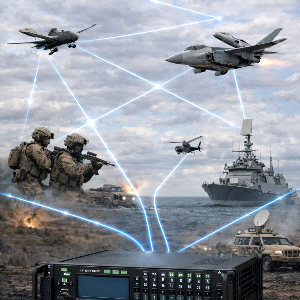
Another defining trend is the increasing need for multi-domain communication integration. Tactical communication systems are no longer limited to ground forces but are now tightly linked with airborne platforms, unmanned systems, and satellite networks. Real-time data exchange between sensors, drones, and command units is enabling faster targeting cycles and improved situational awareness. However, this increased connectivity also expands the attack surface, making cyber and electromagnetic protection an essential component of tactical communication design.
The widespread use of unmanned systems and low-cost drones has further intensified the demand for robust communication networks. Adversaries are leveraging large volumes of drones to saturate defences, requiring continuous data exchange and coordination for detection and interception. Tactical communication systems are playing a vital role in prioritising threats, coordinating responses, and maintaining command and control in highly dynamic scenarios.
From an industrial perspective, these developments are driving accelerated investment in next-generation tactical communication technologies, including SDRs, anti-jam waveforms, secure networking solutions, and integrated SATCOM capabilities. Defence organisations are increasingly prioritising systems that offer flexibility, interoperability, and resilience, recognising that communication superiority is essential for effective operations in contested environments.
As geopolitical tensions continue to rise, a clear lesson is emerging: the ability to win in the electromagnetic spectrum will be as decisive as kinetic capability on the battlefield. Nations that invest in resilient, adaptive, and secure tactical communication systems will gain a critical advantage in future conflicts where connectivity, speed, and coordination define success.
More insights on Tactical Communication Systems and other defence market and technology studies that are available on the MF Inteligencebase platform.
Related Studies